


GLENN MARSHALL - GETTING FILTHY
In my two previous New Cartoonist reviews on pen nibs and inks I felt I came over as a bit of a reactionary who fails to grasp new technology, so I thought I’d put the record straight by talking about fountain pens (which came to prominence in the mid 1900c and that’s pretty hi-tech to me)
As with so many inventions, it’s thought the idea for the fountain pen originated with Leonardo da Vinci (I believe he also foretold the electric toaster and the iPad Air) but it took until the 1820s for these pens to really take off. It was John Scheffer’s patent of 1819 that was the first design to see commercial success, with his ‘Penographic’.
Another early developer was John Jacob Parker who in 1832 patented a ‘self-filler with a screw-operated piston’. Parker of course are still well known for manufacturing pens.
An additional notable pioneer was the Romanian inventor Petrache Poenaru who came up with what he described as the ‘never-ending portable pen, which recharges itself with ink’ and had an ink reservoir made with a swan quill
Two of my favourite ‘drawists’ who often use fountain pens are Róisín Curé (Insta: @roisincure) the self-described ’sketching evangelist’ and Caroline Smith (Insta: @urban_sketchliner) who draws incredible urban landscapes from life. Róisín’s tutorials are fantastic; it was she who inspired me to get the Japanese Sailor Fude nib pen (pronounced FOOD apparently…which is fude for thought) and from her I learned weird alchemy such as mixing THREE colours together, which to me is some sort of voodoo.
Caroline has a interior design background which may play into her architectural artistry - no matter where she goes she is constantly sketching, be it New York’s skyscrapers or the classical buildings in Rome. Once at lunch she kindly gave me my first Platinum Preppy pen: I generously gifted her back the only pen in my bag which was an old BIC biro yet she went on to do some incredible drawings with it (I did say to her, her drawings are astounding but can she draw a chicken playing the banjo?) Caroline has about 111,000 followers on Insta, I have a similar number but without the naughts.
The videos she posts of her drawing are mesmerising. She has her own curated and branded collection of materials for one of the major art supply companies coming out early next year.
One pen I crave that Caroline uses is from the Chicago-based Desiderata Pen Company whose pens are all hand-made.
I particularly like the Bamf which has been customised with the Japanese Zebra G dip pen nib. I can’t really afford the above, it costs more than my first car did although some of the current elite pens from the likes of Mont Blanc cost into the thousands…more than my current car cost.
My Holy Grail has always been a fountain pen that draws like a dip pen with a very flexible line.
I’d read online that people were fitting the Zebra G nib to the very cheap, great utility pen, the Jinhao 750 (you can buy about 5 for £20) There are plenty of online tutorials to help with this but it’s a bit hit and miss. I’ve just used a regular G nib to trial it but will swap it for the tungsten version as the standard one rusted up pretty quickly. These and similar cannibalised pens are known by fountain pen enthusiasts as frankenpens.
You’ll notice in the photos of my pens I often choose ones which are clear plastic. Not only is this laziness as I can see how much ink I have left without unscrewing the barrel but I think they look pretty groooooooovy (I do like a design where you can see the innards - I have a similar Swatch, pocket radio and plastic trousers)
I often wondered why these clear pens are called ‘Demonstrators’ and discovered recently the answer is pretty obvious. Pen salesmen in the late 19th century would sometimes carry a see-though model to demonstrate how the pen worked inside. Often clients really liked the look of them and asked if they could get one so companies started producing them.
I talked about inks in a previous article. With a fountain pen you really should use specific fountain pen inks. NEVER try using a thick drawing ink.
The most popular are water-based dye inks that flow more freely but can fade over time. For drawing I’d recommend a thicker pigment-particle ink. These are more likely to clog up your pen if not frequently used but are much more black and dry water-fast so you can apply washes.
As I said in my paean to ink Platinum Carbon Black is my favourite (recommended by both Róisín’ & Caroline) but DeAtramentstis Document ink is a good slightly cheaper option. Both are really black, waterproof and light-fast (I favour the former as it’s harder to knock the bottle over)
A key feature of the particle inks is that they can’t be erased so are often used to sign important documents. The particles in these inks can settle at the bottom of the bottle, particularly the colour inks, so it’s wise to give them a good shake before use. Some artists go to the extreme of putting small ‘agitator’ glass beads in their bottles which helps dislodge the settled particles.
As I mentioned earlier there are specialists who hand-make fountain pens but there are also specialists who hand-make their own ink. I like KZW from Poland. You can find tutorials online on how to make Iron Gall inks. They use iron and some sort of tannic acid from a vegetable source, frequently oak galls (hence the name) These inks have been made in a similar way going back to the 5th century. They’re not very common now but are also permanent and water resistant. They tend to be a lovely browny-black or purply-black colour but be mindful they can be corrosive if left in a pen unused for too long.
Another fountain pen enthusiast is the fantastic cartoonist Chichi Parish (Insta: @chichiparish) who I bumped into at the London Pen show a few weeks ago - it’s a sort of safe space for pen pervs. The UK Pen Shows are staged around the country, check on their website for details.
Whenever I’ve met Chichi at cartoon events (ie the sadly defunct ‘Cartoonists Whinges’) we’d have a pen off. It was my first visit to the show so she took me around and introduced me to some interesting people including pen guru John Sorowka who will customise and adapt a pen for you after looking at how you write or draw, including grinding the nib to match the angle that you use your pen! I also met the folk from ’Write Here’ a shop from old cartoon festival haunt Shrewsbury. It’s the only dedicated fountain pen store left in the country - I made a pilgrimage there last weekend and it’s a great store. I particularly liked the amazing selection of Japanese inks…but what’s even more amazing is I didn’t buy anything apart from a pencil!
Now one thing you’ll be thinking is hang on, you love the splatter and the splutter and your drawings look like they were done with sump oil and a stick, so how does this fit in with finding pen perfection? Well they’re just lovely things to draw with and make you want to pick them up and get scribbling. I primarily use them when I’m on the move or travelling (have you tried drawing on a RyanAir flight in turbulence with a dip pen and bottle of ink?) I do treat my pens pretty badly and I rarely clean them properly. If they clog up I just dip them in my tea AND then continue to drink the tea. I do miss the sound of a scratchy nib though so use BBC SoundEffect LP No. 34 - Scratchy pens noises on loop.

Pen drawing by Leonardo

Drawing by Róisín Curé of her own produced drawing kit (featuring the Sailor Fude)

Drawing by Caroline In Bologna with
her Bamf pen
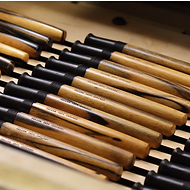
The Desiderata Striata hand-crafted pens

Caroline’s St. Paul’s
drawn with my cheap biro
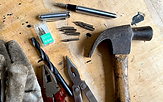
My Jinhao 750 about to go through nib change surgery

My favoured fountain pen inks

Vintage nibs at The London Pen Show.
Birmingham seemed to be a centre for nib production, consequently many early fountain pens were made there too including by my nib nemesis
Joseph Gillott (TNC passim)
...AND TESTING

Ahab pen with inky hand
Noodler’s Ahab pen
I’m very fond of this, it was my first fountain pen bought just for drawing. They are popular with artists as they have a fairly flexible nib. It’s a leaky old thing but I can’t get rid of this faithful friend
(it’s also the one pictured on this article’s title banner)

Rotring pen and ink
Rotring pen and ink
I’ve had this for over thirty years and it’s still going strong. Rotring’s inks are good too. These pens are great to travel with - I like the fact you can fit a spare ink cartridge in the long barrel. A bugger to clean though if you let them clog up. Previous TNC cover stars Martin Rowson and Jeremy Banx use these too.)

Inkursive pen with tin & tea bag
Inkursive Pens Fude nib
This is a nice cheap Fude nib pen manufactured by a small UK company who put them together from Japanese component parts. It comes in a useful tin with a bit of origami and a tea bag (?)

Green sailor pen with converter
Fude De Mannen with Wakatake
55 degree nib
Fude nibs are aimed at the calligraphy market. They’re great at giving line variations depending on the angle you use them, I even use mine upside down to get a super fine line. The ink flow is good too. It’s probably the fountain pen I use most. It’s only available in this green colour and I’d prefer it with a pocket clip as, for one thing, it stops them rolling around. It comes with a couple of Sailor ink cartridges but I’d recommend you buy a converter to put your own choice of ink in. There is a great YouTube tutorial with the hyper-enthusiastic Anne-laure on using Fude pens.

IWSBI pen with packaging
TWSBI Eco
A recent acquisition.
They’re a much loved brand from Taiwan. They only started making their own label fountain pens recently but have manufactured them for other companies for over 50 years. TWSBI’s are great to customise, they provide you with your own little tool kit including a mini spanner and silicon grease for maintenance. They feel very robust too. I’m tempted to also get the slightly cheaper TWSBI GO which has a huge spring-loaded ink reservoir.

Platinum Preppy with St Paul’s drawing
Platinum Preppy
It was one of these that Caroline introduced me to. This is my attempt at drawing St Paul’s which is a bit embarrassing after seeing what Caroline did with a biro. These pens are super cheap so I try and keep one in every bag or jacket pocket. If you bump into me just say ‘I’d like to see your Preppy’.

Pentel Fude Brush Pen
Pentel Fude Brush Pen
Not really a fountain pen but these are great to have in a travel kit, they’re especially good for filling large areas of black. You can use a syringe to refill. These are a big ink leak hazard if squeezed in pockets or baggage so I always carry mine in its own reinforced flight case.
I also always carry a water brush pen as well - very useful for applying washes.
